
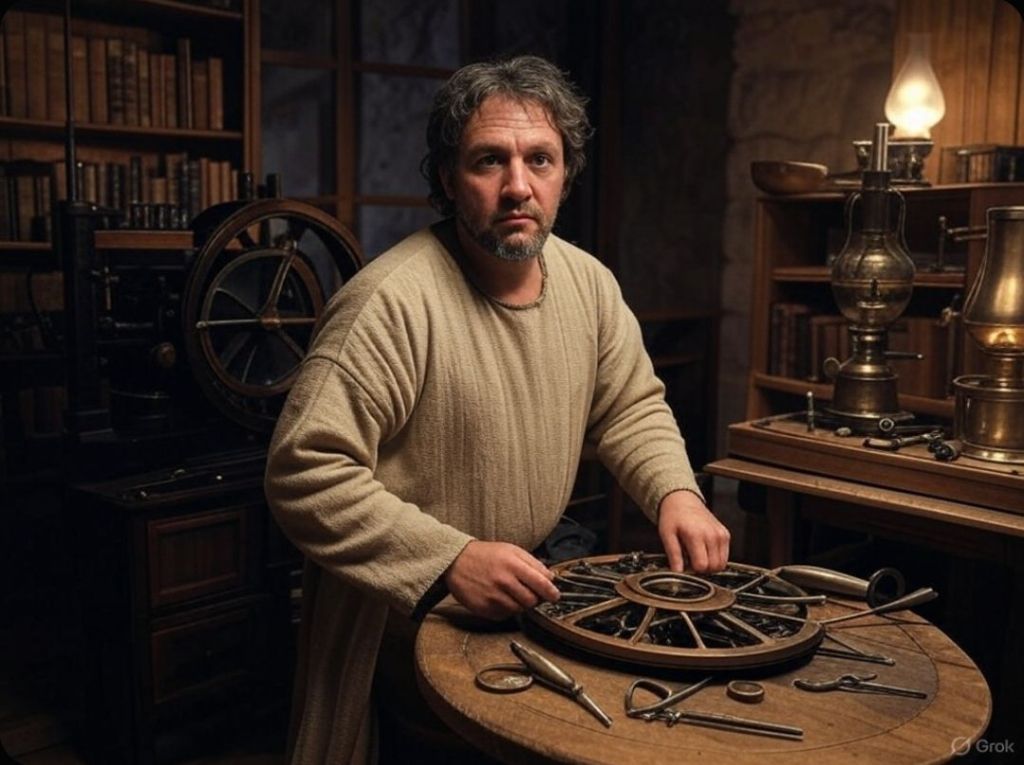
The Unseen Luminary
I am Elias Ward, born in the year of our Lord 1261, in the shadowed streets of York, a city of stone and secrets in the north of England. My tale is one of brilliance and ruin, of visions that danced beyond the grasp of mortal men, and of a mind that burned too brightly for the dim world I was cast into. They call me a genius now, those few who whisper my name, but I was a riddle to my own time—a spark in a damp age, snuffed out by the weight of my own dreams. Let me tell you of my life, my thoughts, and the machines that haunted me until my end in 1316.
The Seed of a Restless Mind
I came into this world in a tanner’s hovel near the Ouse River, the stink of hides and the clamor of merchants my earliest lullabies. My father, John Ward, was a man of rough hands and little patience, a tanner by trade who saw no use in questions beyond the curing of leather. My mother, Agnes, was a weaver with a quiet sharpness to her—a woman who spun tales of the saints as deftly as she spun wool. It was she who first saw the flicker in me, though she scarce understood it. I was a frail child, often ill, and while my brothers wrestled in the muck, I sat by the hearth, tracing patterns in the ash with a stick—lines and circles that seemed to whisper truths I could not yet name.
At seven, I saw a waterwheel on the Ouse, its steady groan pulling buckets from the river’s depths. I asked my father why it turned, and he struck me for idleness. But the question gnawed at me: what force moved it? I began to see the world as a vast machine, each part tugging at another—water, wind, stone, all bound by unseen threads. I had no words for it then, only a hunger to know. The priests at St. Mary’s taught me my letters, grudgingly, for I was no noble’s son, but I devoured their books—Latin tracts on geometry, astronomy, the works of Euclid smuggled from the Moors. My mind raced where my body could not, and I felt a fire kindle within me, a certainty that I could unravel the world’s workings if only I dared
The Shaping Years
By thirteen, I was apprenticed to a blacksmith, Master Hugh of Petergate, a burly man with a bellows-loud voice and a grudging respect for my oddity. I mended tools and stoked fires, but in secret, I sketched machines on scraps of parchment: wheels that spun without water, levers that lifted thrice a man’s weight with a child’s touch. I saw motion as a language, a rhythm I could bend. Hugh caught me once, my hands black with charcoal, and laughed—a rare sound. “You’ll forge naught but trouble, lad,” he said, but he let me keep my drawings.
York in those days buzzed with the shadow of King Edward I, Longshanks, whose armies marched south to crush the Welsh. I saw his siege engines roll through—catapults and trebuchets, miracles of wood and rope that flung death across fields. I stole to the camps at night, sketching their joints and weights, my mind ablaze with questions: Could they be made lighter? Could they harness the wind itself? I began to dream of forces beyond muscle and timber—something wilder, like the lightning that split the sky in summer storms.
At sixteen, I fled the smithy. I could bear no more the hammer’s dull song when my head rang with grander tunes. I wandered to Oxford, a city of scholars cloaked in black robes, drawn by tales of Roger Bacon, the friar who’d penned wonders of optics and alchemy before his death in 1292. His words, smuggled to me by a kindly scribe, spoke of machines that might fly and lenses that pierced the heavens. I had no coin for their schools, but I lingered in their shadows, debating with students in taverns, my tongue sharp and my ideas sharper. They mocked me—a tanner’s son with no Latin grace—but some listened, and one, a young clerk named Thomas de Winton, became my friend. He taught me mathematics beyond Euclid, and together we dreamed of a world remade.
The Rise and the Machines
In 1285, at four-and-twenty, I returned to York, my head brimming with visions. I’d devised a theory: that the world was laced with an invisible force, a subtle fire that coursed through air and earth alike. I called it vis ignota—the unknown power. I saw it in the spark of flint, the pull of lodestone, the fury of thunder. I believed it could be tamed, channeled into machines to lift man beyond his frail flesh. I built my first contraption in a borrowed stable: a wheel of iron and wood, spun by a coil of wire and a lodestone I’d traded a month’s labor for. It turned—slowly, jerkily—but it turned without wind or water. I wept that night, for I’d touched something divine.
Word spread. A merchant, Richard le Scrope, saw my wheel and offered coin to build more. He was a man of ambition, kin to the Archbishop of York, and he saw profit in my strangeness. By 1290, I’d a workshop near Micklegate, a dozen apprentices, and a name whispered in noble halls. I crafted machines: a pump that drew water from wells with a single crank, a mill that ground grain thrice as fast with half the oxen. King Edward himself summoned me in 1296, after his victory at Berwick, to devise a siege engine that could hurl stones with the force of ten trebuchets. I built it—a monstrous thing of taut cables and spinning weights, powered by my vis ignota. It shattered a wall in one blow, and Edward dubbed me “the Fire-Smith.” I was thirty-five, and the world bent to my will.
Yet I had faults aplenty. I was proud—too proud. I scorned the Church’s mutterings that my work bordered on sorcery, and I spurned the guilds who demanded I share my secrets. I trusted few, save Thomas, who’d joined me in York, and even he chafed at my temper. I drove my apprentices hard, my mind leaping ahead of their hands, and many fled. I cared little for coin, giving it away to beggars or squandering it on rare metals, leaving my debts to pile like ash. And I loved unwisely—a widow, Margaret of Fossgate, whose laughter lit my nights but whose kin despised me. My brilliance was my shield, but it made me brittle.
The Fantastic Theories
My greatest works came in the early 1300s. I wrote a treatise, De Ignota Potentia, claiming the vis ignota could light cities, move carts without horses, even send messages across leagues in an instant. I built a device—a cage of wires and glass that crackled with captured lightning, glowing blue in the dark. I showed it to Edward’s court in 1302, and they gasped, but the bishops hissed of devilry. I cared not. I dreamed of a tower that could hurl this force into the sky, a beacon to speak with the stars. I sketched flying machines, too—frames of wood and silk, lifted by heated air, inspired by the kites of the East I’d read of in a Saracen text.
But my theories outpaced my proofs. The vis ignota was fickle—my machines sparked and failed as often as they worked. I lacked the tools to refine them, and my impatience grew. I quarreled with le Scrope, who tired of funding dreams without gold, and with Thomas, who urged caution I could not heed. By 1307, Edward was dead, and his son, Edward II, cared little for my contraptions, embroiled as he was with his barons and his favorite, Piers Gaveston.
The Slow Fall
My decline began in 1309, at eight-and-forty. The Church, egged on by jealous rivals, branded me a heretic. My workshop burned—arson, I knew, though none proved it—and my apprentices scattered. Margaret left me, her family’s threats too great, and Thomas died of fever that winter, taking my last tether to reason. I fled to a hovel outside York, alone with my papers and my failing health. My hands trembled now, my eyes dimmed, but my mind raced still. I built one last machine—a whirring globe of brass and crystal, meant to harness the vis ignota to speak across distances. It hummed once, then fell silent. I had no more to give.
The world forgot me. York’s streets filled with new voices—Robert Bruce’s wars, the famine of 1315—while I withered. I died in 1316, at five-and-fifty, in a pauper’s cot, my papers scattered by wind. They called me mad, a tinkerer who’d flown too near the sun. But I saw what they could not: a future where my vis ignota would light the dark, where machines would sing man’s triumph. I was like no man of my age—my genius was rougher, my time harsher—but I glimpsed the same horizon. And in my lonely end, I smiled, for I knew the spark I’d struck would one day blaze again.

 Dany Slone
Leave a comment