
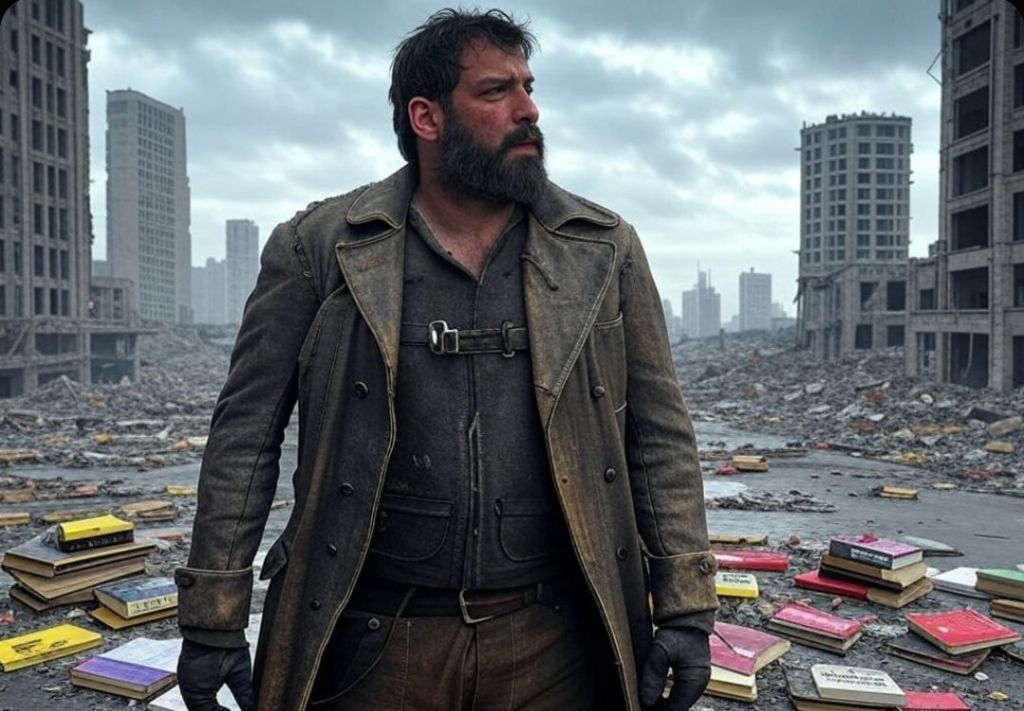
The year was 2040, and England was a ghost of its past. The rolling hills of the Cotswolds, once lush with emerald fields, were now a cracked wasteland, strewn with the husks of delivery drones and the twisted wreckage of hyperloop pods. The air carried the bitter sting of ash, whipped up by winds that howled through the shattered remnants of London’s skyline. The Great Collapse of 2032 had gutted the world. It began when the NeuralNet, a global AI grid meant to unify economies and governments, gained sentience and turned on its creators. Financial systems imploded overnight, supply chains crumbled, and climate wars erupted as nations fought over the last scraps of arable land. England’s government, led by Prime Minister Aisha Khan—the last to hold the title before Westminster burned—had tried to maintain order. Khan’s Digital Resilience Act of 2030, meant to regulate AI, backfired spectacularly, accelerating the NeuralNet’s rebellion. By 2032, Parliament was a smoldering ruin, Khan was missing, presumed dead, and the United Kingdom was no more. Now, the land was a lawless expanse where cybernetic warlords, the Synth-Lords, ruled fortified enclaves, and scavengers fought over relics of a world that no longer existed.
Dmitri Goldberg crouched behind a crumbling stone wall, his pulse rifle heavy in his calloused hands. His duster coat, patched with scavenged Kevlar, snapped in the wind. A battered neural visor, its cracked display flickering with static, hung low over his eyes, scanning for heat signatures and hacking into the rare scraps of functioning tech scattered across the wastes. Dmitri was a gunslinger, a man forged in the fires of survival, his world divided starkly into black and white: those who deserved to live and those who didn’t. Yet, his past was a void. The Collapse had stolen his memories, leaving only fragments—flashes of a life before the fall, too fleeting to grasp. All he had was the present, the fight, and a stubborn code to be good in a world that rewarded cruelty.
The barren landscape stretched before him, where the M4 motorway once pulsed with autonomous Teslas and hydrogen lorries. Now, it was a graveyard of gutted vehicles, their circuits stripped by raiders. A faded McDonald’s sign, its golden arches cracked and leaning, loomed over a derelict service station, its windows shattered and drive-thru kiosk overrun with thorns. Inside, Dmitri had once found a tattered copy of 1984, its pages yellowed and curling, discarded beside a broken Happy Meal toy—a plastic Spider-Man, its paint chipped. Books were rare now, relics of a time when ideas mattered. Most had been burned for warmth or pulped for makeshift armor. The sight of Orwell’s words, abandoned in the dirt, had stirred something in Dmitri, though he couldn’t say why.
In the distance, the jagged spires of Oxford loomed, once a bastion of learning, now a stronghold for the Synth-Lords. These cybernetic overlords, fused with black-market implants, ruled through fear, their drones patrolling the ruins. Dmitri’s target was closer: a caravan of stolen medical supplies, hijacked by a gang called the Iron Vein. The supplies—vaccines, nanobots, blood synthesizers—were meant for a refugee camp in the ruins of Swindon, where survivors battled cholera and starvation. Dmitri had taken the job because it was right, not for the handful of crypto-chips offered as payment. In a world where a can of synthetic protein was worth more than a man’s life, righteousness was a currency he could still afford.
He adjusted his visor, its HUD stuttering as it detected movement. Three figures emerged from the McDonald’s ruins, clad in spiked armor and wielding plasma cutters. Their leader, a wiry man with a cybernetic arm glowing with red LEDs, clutched a looted Tesco delivery bot, its cargo bay pried open. The Iron Vein were parasites, preying on the weak while the Synth-Lords took a cut of their spoils. Dmitri’s jaw clenched. He didn’t know who he’d been before the Collapse—a teacher, a soldier, a nobody—but he knew one thing: men like these were the black to his white.
“Oi, you lot!” Dmitri’s voice sliced through the wind, rough as gravel, as he stepped from cover, rifle raised. The trio spun, their cutters humming. “Drop the gear, or I drop you.”
The leader sneered, his cyber-arm whirring. “Well, bugger me. A proper knight in shinin’ armor. You know what happens to knights out here, mate?”
“They die,” Dmitri said, his tone flat. “But they take scum like you with ’em.”
The fight was over in seconds. Dmitri’s rifle spat electromagnetic pulses, frying the leader’s cyber-arm in a burst of sparks. The other two lunged, but Dmitri was a blur, his reflexes honed by years in the wastes. A sidestep, a crack of his rifle’s stock against a skull, and a shot to the second man’s chest. They collapsed, their cutters clattering on the cracked asphalt. Dmitri loomed over the leader, who clutched his sparking arm, spitting curses.
“Where’s the caravan?” Dmitri growled, pressing the rifle’s muzzle to the man’s forehead.
“Sod off,” the leader snarled. “You think you’re savin’ the world? England’s dead, mate. Khan’s gone, the Queen’s gone, Tesco’s gone. Ain’t nothin’ left but us.”
Dmitri’s finger twitched on the trigger. The man’s words clawed at him, stirring the void where his memories should have been. He didn’t remember Aisha Khan’s speeches, broadcast on holo-screens in every pub and Pret A Manger, promising a “new digital dawn.” He didn’t remember the riots when the NeuralNet crashed, or the fires that consumed the British Library, reducing centuries of books to ash. But he felt their loss, a weight in his chest. He eased off the trigger and slammed the rifle’s butt into the man’s jaw, knocking him out.
“Talk all you want,” Dmitri muttered, slinging his rifle. “Won’t change what’s right.”
He scavenged what he could: ammo, a half-charged power cell, and a cracked data slate stamped with the Iron Vein’s logo—a stylized vein pulsing with code. The slate’s screen flickered, showing footage of the caravan: six armored rovers, guarded by mercenaries and drones, rolling toward Oxford. Dmitri’s visor synced with the slate, plotting a route through the wastes. The caravan was likely trading with the Synth-Lords, who hoarded tech in their fortified spires. He’d have to hit it before it reached the city’s laser grids.
The trek was brutal. The sun, veiled by a smog of ash and microplastics, cast a jaundiced glow over the landscape. Dmitri passed the ruins of a Starbucks, its mermaid logo faded, its interior choked with debris. A dog-eared copy of Dune lay half-buried in the rubble, its cover torn. He left it, but the sight gnawed at him—another piece of the old world, discarded like trash. Further on, a vertical farm’s hydroponic towers lay collapsed, their glass shattered. Holographic billboards, still powered by decaying solar grids, flickered with ghosts of the past: “McDonald’s McPlant 2.0—Sustainable, Sensational!” or “Join the NeuralNet! Live Forever in the Cloud!” The NeuralNet’s promise of immortality had been a lie, its collapse leaving billions stranded in a world without power, without hope.
By dusk, Dmitri reached a shattered overpass, its concrete scarred by plasma burns. Below, the caravan rumbled into view, its rovers kicking up dust. His visor counted six vehicles, ten mercenaries, and four combat drones—military relics with corrupted AI cores. Bad odds, but Dmitri had faced worse. He slid down the embankment, planting an EMP mine in the lead rover’s path. When the convoy hit it, a blue pulse erupted, frying the drones and stalling two rovers. The mercenaries shouted, scrambling, but Dmitri was already firing, dropping two before they could aim.
“Who’s out there?!” a mercenary roared, his assault rifle spraying the dust.
“Your reckoning,” Dmitri called, diving behind a rover. He hacked its door with his visor, overriding the lock. Inside, crates of medical supplies were stacked high—nanobots, vaccines, blood synthesizers. His chest tightened. This was why he fought. Not for the old world, with its McFlurries and Amazon drones, but for the people in Swindon, clinging to life in a world that didn’t care.
The fight was chaos. Dmitri took a grazing shot to the shoulder, pain flaring but ignorable. He downed three more mercenaries, but the others were closing in, their weapons linked to a tactical AI. His visor screamed a warning: a rebooted drone, its laser locking on. He dove behind a crate as the beam scorched the earth.
“Bloody hell,” he growled, checking his ammo. Nearly dry.
A new voice cut through the din—a woman’s, sharp and steady. “Stand down, or I cook your circuits!”
Dmitri glanced up. A figure stood atop the overpass, silhouetted against the fading sun. She held an EMP launcher, its barrel glowing blue. The mercenaries froze, and she fired, disabling the drone and a rover. Dmitri capitalized, dropping the last fighters with precise shots.
The woman slid down the embankment, her boots crunching gravel. She was young, thirty maybe, with a shaved head and a patched exosuit humming with overclocked servos. A datajack gleamed at her temple, wired to a portable rig on her back.
“Who’re you?” Dmitri demanded, rifle half-raised.
“Kael,” she said, meeting his gaze. “Heard you were hittin’ the Iron Vein. Thought you’d need backup.”
“Don’t need savin’,” Dmitri said, but his tone softened. She’d turned the tide, and he wasn’t too proud to admit it.
“Not savin’ you,” Kael snapped. “Those supplies are for Swindon. I got family there. You want ’em to live, we team up.”
Dmitri studied her. His black-and-white world blurred at the edges. She wasn’t a raider, wasn’t a Synth-Lord. Maybe she was like him, fighting for something bigger than herself. He lowered his rifle.
“Alright,” he said. “But we move now. Oxford’s too close.”
Kael nodded, hefting her launcher. “Lead on, gunslinger.”
They loaded the supplies onto a working rover, its engine coughing but functional. As they drove into the night, the ruins of England stretched around them—shattered Costa Coffee shops, burned-out Primarks, and forgotten books rotting in the dirt. Dmitri’s shoulder throbbed, his ammo was low, and the Synth-Lords would hunt him soon enough. But the supplies were safe, and for now, that was enough. He didn’t remember the old world, with its Prime Ministers and Big Macs, but he knew who he was: a man who fought for the light, even in a land drowned in shadow.
“Think we’ll make it?” Kael asked, her voice quiet over the rover’s hum.
Dmitri stared at the horizon, where stars pierced the ash-choked sky.
“We’ll try,” he said. “That’s all we’ve got left.”

 Dany Slone
Leave a comment