
The Hawthorn Tree Series
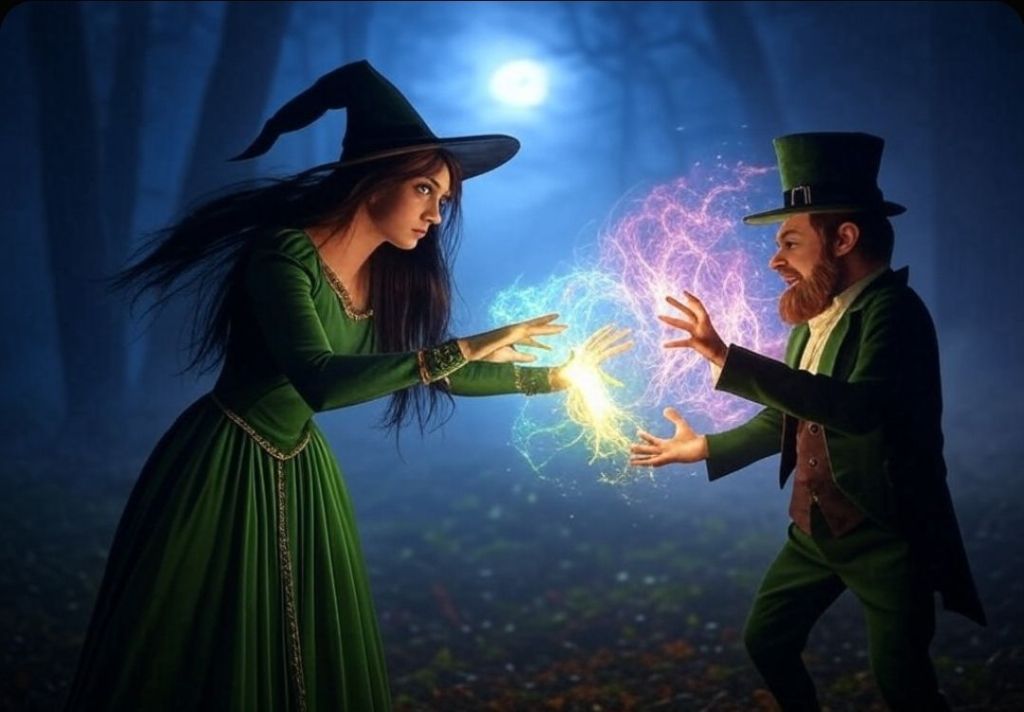
The cottage crouched in the shadow of a gnarled forest, its walls sagging like a hag’s flesh, patched with moss and rot. Inside, the air was a sour stew of damp earth, burnt herbs, and something acrid that clawed at the throat. A cauldron squatted over a fire that spat green sparks, its contents bubbling and glopping like a living thing, hissing secrets in tongues older than the stones. Margharta, the wild-eyed witch, stumbled through the clutter—her bare feet slapping the dirt floor, her white hair a tangled shroud whipping around a face carved by time and spite. Her eyes, milky and unmoored, rolled in their sockets as she rummaged through the chaos: overturned pots crusted with ash, a broom that twitched faintly, a shelf of jars glowing faintly with captured will-o’-wisps.
“Where is it, ye cursed thing?” she muttered, her voice a rasp that could peel bark. She clawed under a table, scattering soot and mouse bones, until her fingers brushed a cool glass jar. She yanked it free, cackling—a sound like a crow choking on its own glee. The liquid inside shimmered clear as moonlight, trembling with a pulse of its own. “Hawthorn sap,” she crooned, hobbling to the cauldron. “Youth in a drop, power in a sip. Ye’ll fix me yet.”
“I wouldn’t do that if I were ye!” piped a voice, small but sharp as a thorn. Margharta froze, her lips curling into a grin that showed teeth yellowed and jagged. She didn’t turn, just narrowed her eyes to the side.
“Conarght,” she hissed, spinning with a mock bow that sent her hair flailing. “Always a pleasure, ye meddlin’ runt.”
In the doorway stood a leprechaun, no taller than a foot, his brown beard spilling over a tunic of patched green. His red hat—bright as fresh blood—cut through the gloom, cocked jauntily over eyes that twinkled with mischief and age. He leaned on a gnarled stick, smirking up at her. “And the same to ye, Margharta, ye old bat. What’s that ye’ve got there?” He nodded at the jar, his tone light but edged.
She clutched it tighter, swaying like a drunk between the cottage’s broken beams. “This? Oh, just a tonic for me health, dear friend!” She screeched a laugh, loud enough to rattle the rafters, and Conarght rolled his eyes.
“Health, she says,” he muttered under his breath. “Ye’re madder than a sack of cats in a rainstorm.” Louder, he said, “That’s hawthorn sap, ye daft crone! Sacred as the Morrigan’s tears—ye don’t guzzle it like cheap ale. When will ye mortals learn the old laws?”
Margharta’s grin twisted, her eyes glinting with something feral. “Mortal, am I? We both know better, don’t we, me wee savior?” She danced closer, her shadow stretching long and crooked. “A hundred years I’ve festered like this—cursed by yer own hand! What’s a sip of sap to a hag like me? No worse than the rot ye wished on me!”
Conarght’s smirk faded, his voice dropping low. “Don’t, Margharta. Ye don’t know what ye’ll wake. The hawthorn’s tied to the Sí—the fairy folk—and they don’t take kindly to thieves. Ye’ll call somethin’ darker than me.”
She unstoppered the jar with a pop, locking eyes with him as she tipped it toward the cauldron. “Let it come,” she snarled. But the liquid defied her—swirling midair, it veered away, splashing harmlessly into the dirt. She shrieked a curse that made the fire flare blue, shaking her fist at him. “Ye thievin’ imp!”
Conarght stood firm, finger wagging. “Don’t meddle in what’s not yers! That tree’s mine—home to my kin since the Tuatha Dé walked the hills. Touch it again, and ye’ll rue it.” With a tip of his hat, he vanished into the night, leaving a faint giggle on the wind. Margharta glared after him, then snatched the jar—only to find it swapped for a bottle of stout. Her scream tore through the forest, a banshee’s wail of rage, and two miles off, Conarght heard it as he slipped through a portal in the hawthorn’s roots, chuckling into his beard. She’d try again, he knew. She always did.
Conarght thought back to their first meeting.
Their story stretched back to 1710, to a misty night in Islandmagee, where the wind carried the keening of the sea and the land thrummed with old magic. Conarght, ever the mischief-maker, had been drawn to a cottage by a woman’s screams—wild, unhinged, deliciously chaotic. He’d hopped to the sill, peering through a cracked pane. Inside, a widow sat at a table, her face a mask of terror as she shrieked, “Leave me be!” Plates soared like mad birds, smashing into walls; cups spun in midair; chairs scraped the floor like restless spirits. Conarght grinned, tipping his hat to her. A poltergeist, perhaps—or better yet, a witch’s spite.
He followed the magic’s pull, a beacon through brambles and into a forest where the air buzzed with power. There, beneath a waning moon, stood Margharta—young then, no more than twenty-five, her jet-black hair streaked with white, a mark of death’s touch. Her hips swayed as she waved her hands, conducting an invisible orchestra of malice. She cackled, drunk on her craft, until four burly men burst from the shadows.
“Margharta!” roared their leader, a grizzled brute with a rope in hand. “Ye’re on trial for witchin’ that widow!” They seized her—arms, legs, thrashing limbs—and bound her to a tree, barking questions she ignored. Conarght watched, unseen, giggling at the drama—until her eyes locked on his. She saw him, damn her sight, and her lips split into a wicked grin.
“What say ye, witch?” the leader demanded. “Tormentin’ that widow yonder?”
“Yes!” she screeched, her voice a blade through the night. “She murdered my lover—her husband! She deserves the Sluagh to rip her soul!” Her gaze slid to Conarght. “I wish ye four would die slow and painful!”
Conarght groaned—three wishes, the old bargain—but flicked his hand. The men clutched their chests, gasping as their lungs filled with phantom water, drowning on dry land. For hours they writhed, screaming, begging, until the last wheezed his plea for death. Margharta cackled through it all, a symphony of glee.
“Show yerself, leprechaun!” she crowed. He appeared, grimacing. “Where’d ye get that power?” he asked, wary. She was no ordinary mortal.
“Me mam’s line runs deep with magic,” she purred, “and I sealed it with the devil’s own handshake. What’s it to ye?” Conarght laughed—always the devil with these fools—but she didn’t join him. “I wish these ropes gone,” she snapped. He flicked his hand, and they fell. She knelt, drawing stars on the dead men’s foreheads—curses, not blessings, he knew, to plague their kin.
“Why burn yer wishes so fast?” he asked, scratching under his hat.
“I don’t need ye!” she spat, storming toward him. “I wish to live forever—now begone!” He sighed, flicked his hand, and vanished, but not before meddling one last time. At the widow’s cottage, he rubbed his hands, sending a beam of joy through the window. The widow wept tears of relief, her torment ended. Margharta charged the house, but Conarght struck her down with a spell, pinning her to the earth.
“Ye’re barred from her and hers,” he boomed, “from now ‘til the sun dies. The magic’ll turn on ye tenfold if ye try.” She spat, cursed, and fled, her sobs swallowed by the night.
———-‐—-‐———————-
For two weeks after the bottle spat, Conarght spied on her, perched in the tree’s branches or cloaked in shadow. She was a storm of malice, digging at its roots, recoiling as the Sí’s wrath flung her across the forest floor. She landed in a heap, muttering curses at the moon. “Show yerself, devil,” she growled, voice thin.
He appeared by her foot, his red hat stark against her withered frame—skin like parchment, eyes blazing with unspent fury. “Ye did this,” she accused, shaking debris from her rags. “All I want’s a drop of sap for youth—why deny me?”
“Ye wished to live forever,” he shot back, pointing. “Ye should’ve known better’n to waste a wish on a leprechaun’s whim. That sap’s Sí blood—sacred, guarded. Ye’d wake the Banshee herself, screamin’ yer doom.”
She lunged to kick him, but he dodged, leaves swirling in her wake. He giggled, though pity flickered in his chest—not sadness, but a faint ache for the beauty she’d been, now a hag doomed to crumble. She sobbed, and he sat on a stone, feet dangling. “Why us, eh? Why d’we keep tanglin’?”
“Ye meddle,” she said, wiping tears. “I erred with a wish—can ye undo it?”
He shook his head, pacing. “No unwishin’ a wish, ye fool. But…” He peered into his hat, whispering to unseen voices, then looked up. “There’s a way—give up yer magic.”
She erupted, trembling with rage. A lightning bolt crackled from her hand, hurtling at him. He flicked it back like a toy, and it slammed her to the ground, stunned but alive. Tutting, he levitated her, guiding her to the hawthorn. A black mist parted—a portal—and they stepped into a blinding white void, pristine and endless.
“Where am I?” she gasped, patting herself.
“Deep in me magic,” he said. “Think what ye want—youth, beauty, peace. Ye’ll never age here, but ye can’t harm a soul. Yer kingdom, Margharta.”
“Prisoner, then!” she snarled.
“Nay,” he grinned, smug. “Best offer ye’ll get—or I take yer magic.” She glared, but he turned, flicking the mist open. “Farewell, angry witch!” He bowed, hat in hand, and stepped through, leaving her in the illusion—a trap, not his home. She’d rage there for eons, never touching the world again.
Under a full moon, Conarght sometimes heard her faint cries, a banshee’s echo from the void. He smiled, knowing she’d earned it—arrogance undone by a leprechaun’s guile. The forest sighed in relief, free of the wild-eyed witch at last.

 Dany Slone
Leave a comment