
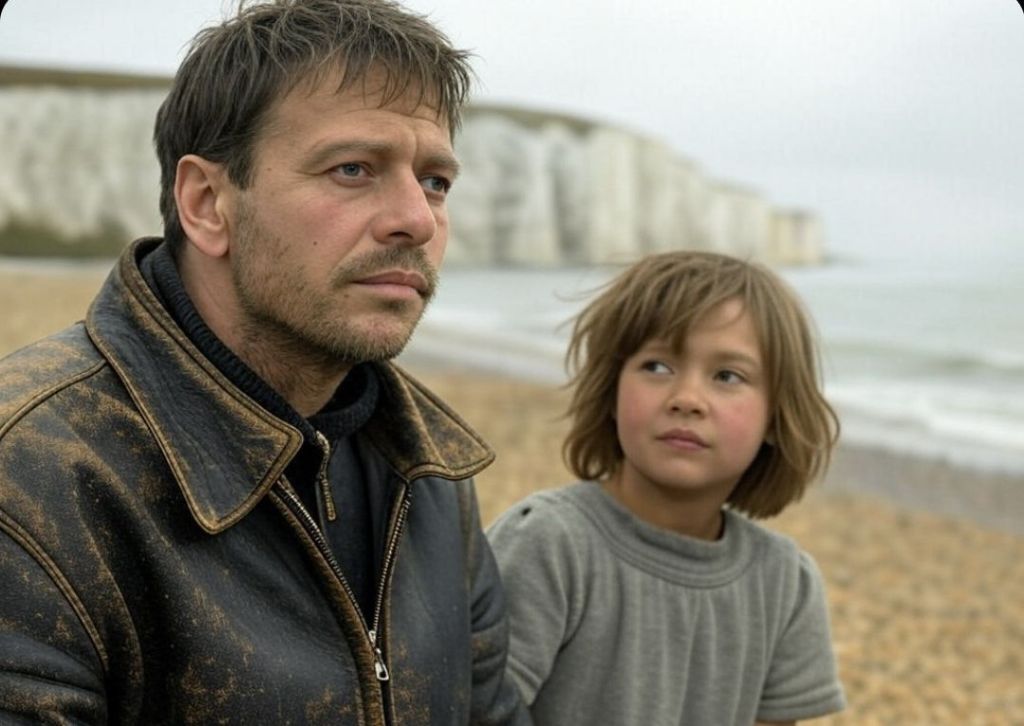
In the autumn of 1973, the chalk cliffs of Kent loomed over the grey churn of the English Channel, their white faces streaked with flint and despair. Dover’s streets, damp with the salt-kissed mist, wound through a town battered by economic rot and the weight of a government that seemed to care more for Whitehall’s polish than the working man’s grind. The docks, once alive with the clatter of trade, now groaned under the shadow of strikes and closures. It was here, in a crumbling terrace house on Priory Road, that Jack Tanner lived, if you could call it living.
Jack was a wiry man of thirty-two, his face etched with lines that belonged to someone twice his age. His dark hair hung greasy over eyes that burned with a quiet, smouldering rage. A docker by trade, he’d been laid off when the unions clashed with management, leaving him to scrape by on odd jobs and bitterness. His bedsit smelled of damp plaster and cigarette smoke, the walls papered with peeling floral patterns and his own resentment. He hated the world, the government with its suited liars, the bosses who’d sold out the workers, the neighbours who’d stopped looking him in the eye. Most of all, he hated himself for believing, once, that things could be better.
“Bloody Heath and his three-day week,” Jack muttered, flicking ash into a chipped teacup. He sat at his wobbly table, a transistor radio spitting static and news of power cuts. “Starve us, freeze us, and call it progress. Bastards.” He took a swig of cheap whisky, the burn doing little to thaw the ice in his chest.
Outside, the world moved on without him. Kids played football in the street, their shouts muffled by the fog. Jack ignored them, as he ignored most things. But that afternoon, as he trudged to the corner shop for fags, something, or rather, someone broke through his haze.
She was small, no more than nine, with a mop of chestnut curls and a face smudged with dirt. Her coat was too big, the sleeves dangling past her knuckles, and her shoes were scuffed to near ruin. She sat on the kerb outside the shop, clutching a tattered book, her eyes wide and searching. Jack tried to step past her, but she looked up, and her gaze pinned him like a butterfly to a board.
“Got a penny for a sweet?” she asked, her voice bright despite the quiver in it.
Jack snorted, fishing in his pocket. “What’s a kid like you doing out here, begging? Where’s your mum?”
The girl’s face fell, just for a moment, before she squared her shoulders. “Ain’t got one. Ain’t got a dad neither. Just me.”
Jack froze, the penny still in his hand. He’d seen plenty of strays in Dover, kids left to fend for themselves when families cracked under the weight of poverty. But something about this one, her defiance wrapped in fragility, snagged on the jagged edges of his heart.
“Here,” he said gruffly, tossing her the coin. “Don’t spend it on rubbish.”
She caught it with a grin. “Thanks, mister! I’m Lily, by the way. What’s your name?”
“Jack,” he muttered, already turning to leave. “And don’t follow me.”
But Lily did follow him, not that day but the next, and the one after that. She’d appear like a stray cat, popping up outside the shop or on the cinder path that wound behind his street, her book always in hand. Jack grumbled, told her to bugger off, but she’d just laugh, her voice like a bell cutting through the fog.
“You’re grumpy as a badger, Jack,” she said one day, skipping alongside him as he hauled a sack of coal home. The path was slick with mud, the air heavy with the scent of wet earth and distant sea. “But you ain’t mean. I can tell.”
“You don’t know me, kid,” he snapped, his breath clouding in the chill. “World’s a rotten place, and I’m no different.”
Lily tilted her head, her curls bouncing. “World’s not all bad. Look!” She pointed at a patch of wildflowers poking through the cinders, their purple petals defiant against the grey. “Pretty, ain’t they?”
Jack grunted, but he looked. And for the first time in years, he noticed something beautiful.
Over the weeks, Lily became a fixture in Jack’s life, whether he liked it or not. She’d knock on his door, her book tucked under her arm, and he’d let her in, muttering about how she was a nuisance. But he’d make her tea, weak and milky, and she’d sit cross-legged on his threadbare rug, reading aloud from her book. a dog-eared copy of The Secret Garden. Her voice, clear and earnest, filled the room with something Jack hadn’t felt in years: warmth.
“You read like you believe in all that nonsense,” he said one evening, sprawled in his armchair, a fag dangling from his lips. The room was dim, lit only by a single bulb and the glow of a paraffin heater. “Secret gardens and happy endings. Life ain’t like that.”
Lily looked up, her eyes fierce. “It can be. You just gotta make it that way. Mary in the book, she was all sour and sad, but she found the garden, and it changed her. Maybe you just ain’t found your garden yet, Jack.”
He laughed, a harsh bark that turned into a cough. “My garden’s a slag heap, kid. Nothing grows there.”
She grinned, undeterred. “Bet I could make it grow. I’m good with plants. Found some daisies by the docks once, kept ‘em alive for weeks.”
Jack shook his head, but the corner of his mouth twitched. “You’re daft, Lily. Daft as a brush.”
As winter crept in, Jack learned more about her. Lily was an orphan, shuffled between foster homes until she’d run away from the last one, a grim place in Folkestone where the foster mother cared more for the council’s cheques than the kids. She’d been sleeping in doorways, scavenging for food, but her spirit hadn’t broken. She talked about the stars, the sea, the stories in her book, and Jack listened, his walls crumbling despite himself.
One night, as rain lashed the windows, Lily turned up soaked and shivering. Jack swore under his breath, dragging her inside and wrapping her in his only blanket. “You can’t keep living like this, kid,” he said, his voice rough with something close to fear. “You’ll catch your death.”
“I’m fine,” she said, teeth chattering. “I’ve got my book. Keeps me warm.”
“A book ain’t a home,” he snapped. He paused, staring at the girl who’d somehow become his reason to get up each morning. “You’re staying here. Proper like. I’ll sort it.”
Lily’s eyes widened. “You mean it, Jack? You’d keep me?”
He looked away, his throat tight. “Don’t make a fuss. Just… don’t run off again, alright?”
Sorting it wasn’t easy. Jack had to face the council, a maze of forms and suspicious officials who looked at his dingy bedsit and scarred knuckles with disdain. “A man like you, raising a child?” one clerk sneered, peering over his glasses. “What’s your game, Tanner?”
“My game’s giving her a chance,” Jack growled, his fists clenched. “Better than your lot, leaving her on the streets.”
He fought for her, tooth and nail, and in the spring of 1974, Lily was officially his ward. It wasn’t a fairy tale—Jack was still broke, still angry at a world that seemed rigged against him. But Lily changed things. She dragged him to the cliffs on sunny days, pointing out gulls and ships, her laughter brighter than the sun on the waves. She planted daisies in cracked pots outside his door, and when they bloomed, Jack felt a flicker of hope he thought he’d buried long ago.
One afternoon, as they sat on the cinder path, Lily reading while Jack smoked, she looked up and said, “You’re different now, Jack. You smile sometimes. Like you mean it.”
He snorted, but his eyes were soft. “That’s your fault, kid. You’re a bloody menace.”
She giggled, then grew serious. “You’re my garden, Jack. You grew.”
He didn’t answer, just ruffled her hair, but the words sank deep.
The final shift came that summer. Dover was buzzing with talk of a community centre, a project to give kids a place to go instead of the streets. The council was dragging its feet, citing budgets, but Jack saw Lily’s face when she heard about, hopeful like she could see a future where kids like her weren’t forgotten. For the first time, he didn’t just curse the system. He acted.
He rallied the dockers, the shopkeepers, anyone who’d listen. He stood in pubs, his voice hoarse but steady, talking about a place for the kids, for Lily. “Government won’t do it,” he said, pint in hand. “But we can. For our own.”
It wasn’t easy. Jack faced jeers, apathy, even threats from a local thug who wanted the land for his own schemes. But Jack, once a man who’d given up, fought like a lion. He organised fundraisers, hauled bricks, painted walls. Lily was there, too, her small hands planting flowers around the site, her laughter spurring him on.
By autumn, the centre opened, a modest building, but warm and alive with kids’ voices. At the opening, Lily stood on a crate, reading from The Secret Garden to a crowd of rough men and tired mothers, her voice carrying over the cliffs. Jack watched, his chest tight with pride, and realised he wasn’t the man he’d been. The world was still broken, but he’d built something good in it.
Later, as they walked home along the cinder path, Lily slipped her hand into his. “You’re a hero, Jack,” she said.
He laughed, a real laugh, light and free. “Nah, kid. I’m just yours.”
And in that moment, under the Kent sky, Jack Tanner—gritty, broken, redeemed—knew he’d found his garden, and it was blooming.

 Dany Slone
Leave a comment